
How Long Should You Wear a Red Light Therapy Mask?
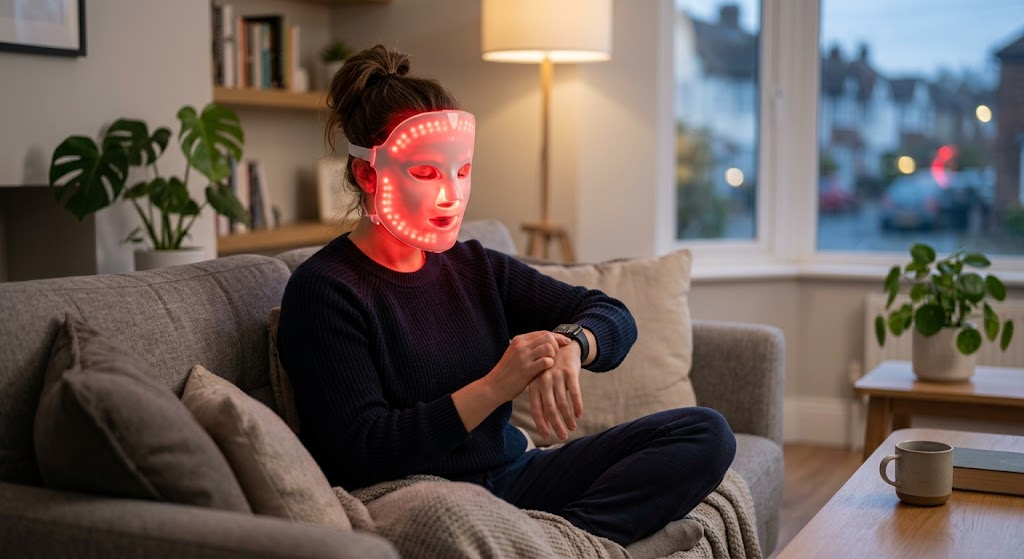
The short answer: 10–20 minutes per session, 3–5 times per week for most masks — check your device’s spec sheet, because session length depends on irradiance. The math: dose (J/cm²) = irradiance (mW/cm²) × time, and clinical protocols target roughly 30–60 J/cm² per session[1][2]. Longer is not better: photobiomodulation has a biphasic dose response, so overuse can blunt results. Expect cumulative improvement over 8–12 weeks[3].
Table of Contents
- 1. The Short Answer: 10–20 Minutes, 3–5×/Week
- 2. The Dose Math Behind Session Length
- 3. Session Duration by Goal and Skin Type
- 4. Frequency: Build Phase vs. Maintenance Phase
- 5. Can You Overuse a Red Light Mask?
- 6. Partner With CANTOPLED Technology for Custom LED Devices
- 7. References & External Links
1. The Short Answer: 10–20 Minutes, 3–5×/Week
For most FDA-cleared red light therapy masks — including the CANTOPLED LED Mask (10 minutes, 3–5×/week) — the standard protocol is 10–20 minutes per session, 3–5 times per week. Here is how the market’s recommended protocols cluster:
| Typical Protocol | Session Length | Frequency |
|---|---|---|
| Standard anti-aging | 10 minutes | 3–5×/week |
| Extended / lower-irradiance devices | 15–20 minutes | 3–4×/week |
| Beginner / sensitive skin | 3–5 minutes, build up | Start 2–3×/week, increase |
These protocols cluster around 10–20 minutes for a reason — not habit, but physics and biology, explained next.
2. The Dose Math Behind Session Length
Session length is a dose calculation, not a preference. The energy delivered to skin is:
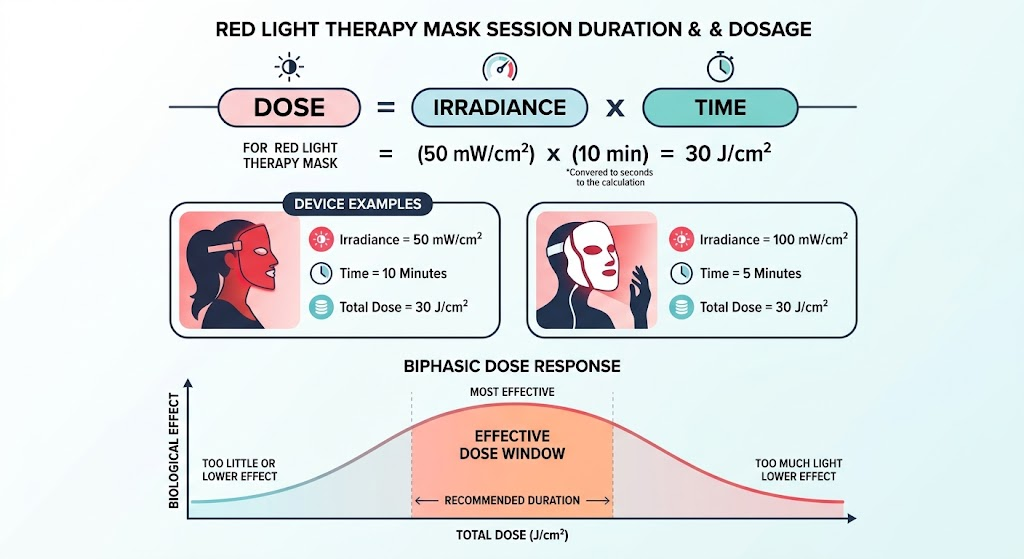
Dose (J/cm²) = Irradiance (mW/cm²) × Time (seconds) ÷ 1000
Clinical protocols typically target roughly 30–60 J/cm² per session[1][2]. Two worked examples:
| Device Irradiance | Session | Dose Delivered |
|---|---|---|
| ~50 mW/cm² | 10 minutes | 30 J/cm² ✓ in window |
| ~25 mW/cm² | 20 minutes | 30 J/cm² ✓ in window |
This is why a 20-minute protocol is not “stronger” than a 10-minute one — it may simply be a lower-irradiance device compensating. It also explains why you should trust your device’s manual over generic advice: the correct session length depends on the mW/cm² your specific mask delivers at skin[1]. What to check on a spec sheet: what to look for in a mask.
3. Session Duration by Goal and Skin Type
Within the 10–20 minute window, your goal and skin type adjust where you start:
| Situation | Recommended Start | Build-Up |
|---|---|---|
| First-time user | 3–5 minutes | +2–3 min/session over 1–2 weeks |
| Sensitive skin | 5 minutes | Lower intensity; extend only if no reaction |
| Standard anti-aging | 10 minutes | Up to 20 min only per device manual |
| Acne (blue mode) | 5–10 minutes | Blue light is potent; respect the manual[4] |
Full usage routine: the 7-step red light mask routine.
4. Frequency: Build Phase vs. Maintenance Phase
Frequency follows a two-phase structure:
| Phase | Frequency | Duration |
|---|---|---|
| Build phase | 3–5×/week | 8–12 weeks — the window where clinical endpoints are measured[3] |
| Maintenance phase | 2–3×/week | Ongoing — sustains collagen density gains[3] |
Daily use is generally unnecessary for red-only masks; the clinical literature centers on 3–5 sessions weekly. For masks with blue modes, respect the manual’s frequency cap — blue protocols are typically shorter and less frequent[4]. More on schedules: how often to use a red light mask.
5. Can You Overuse a Red Light Mask?
Yes — and the mechanism is worth understanding. Photobiomodulation follows a biphasic dose response: below the effective window, nothing happens; inside it, the beneficial cellular signaling occurs; above it, the same pathways can be inhibited[1]. In practical terms:
- Longer sessions ≠ better results. Doubling time past the therapeutic window can reduce the response.
- Daily use of red-only masks is safe for most people but usually unnecessary — 3–5×/week captures the clinical benefit[3].
- Watch for dryness or irritation. If skin feels tight or reactive, reduce session length and frequency, not the other way.
- Follow the manual. The manufacturer calibrated session length to the device’s irradiance; generic “more is better” advice from any source is wrong[2].
6. Partner With CANTOPLED Technology for Custom LED Devices
Session duration is a specification your manufacturer gets right — or gets wrong. Calibrating irradiance, setting auto-timers to land in the therapeutic window, and documenting dose in the manual is part of responsible device design. That is the daily work of CANTOPLED Technology’s Shenzhen R&D and production teams. As an ISO 13485, CE, and FDA-compliant LED device manufacturer, we support:
- Custom mask, panel, and multi-wavelength device design with verified optical specifications.
- ODM/OEM production — including private label — from prototyping to mass production.
- Full regulatory documentation (ISO 13485, CE, FDA 510(k) support) for your market entry.
Building a light therapy brand? Visit our OEM/ODM Manufacturing Page or request your custom quote today.